
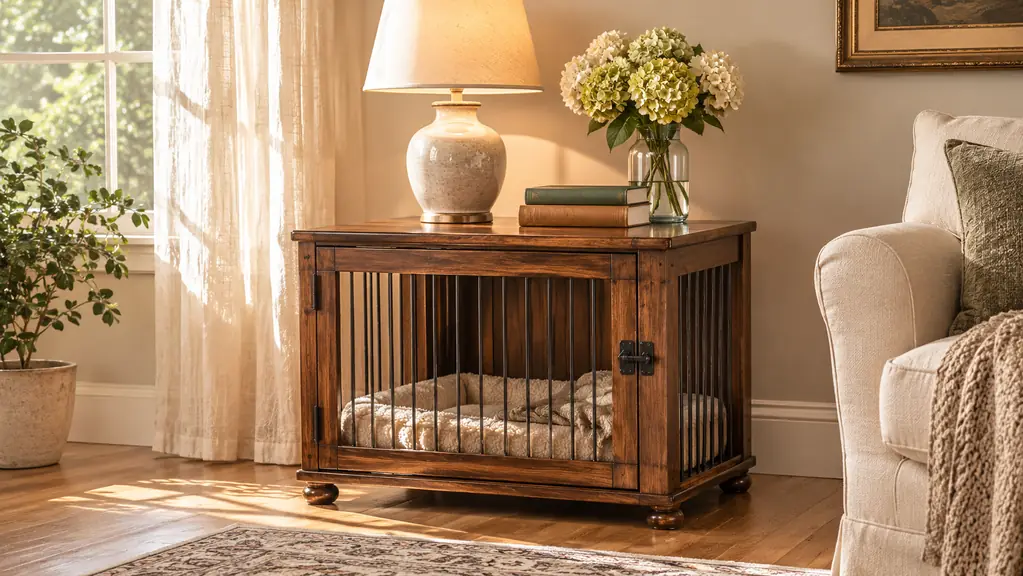
The wire crate was the first thing I moved out of my living room and the last thing I wanted back. It sat in the corner like a piece of gym equipment, all thin bars and visible tray, and every time I walked past it I felt like I was apologizing for my own house. I tried the usual fixes. A fabric cover that collected dust and made the whole thing look like a covered piece of gym equipment. A folding screen that Juniper simply walked around. Moving the crate to the guest room, which mostly meant I stopped using it and she lost the spot she liked.
So when I started shopping for something with panels instead of bars, I was picky in a way that probably made me tiresome. I wanted a piece that read as furniture from across the room, and I wanted to know what it was made of before I let my dog sleep inside it. What ended up beside my sofa is the New Age Pet ECOFLEX furniture style dog crate and end table, Medium size, and it has been in daily use in my 1940s bungalow for months now. This is the honest version. What held up, what did not, and who I would and would not hand this recommendation to.
The Quick Verdict
A genuinely good-looking crate that solves the living room problem, with one caveat the listing states plainly and most buyers skim past: it is built for calm, crate-trained adult dogs, not for dogs who work at doors.
Amazon Check Today's Price →The crate that stopped being the worst-looking thing in the room
Four sizes, stainless steel hardware, and a finish that goes all the way through the material instead of sitting on top of it. Check the size chart against your dog's length before you order.
Amazon Check Today's Price on Amazon →How I've Used It
Juniper is a six-year-old mixed breed, about 45 pounds, and she sheds year round. She is crate trained and she is calm in a crate, and that second fact matters more than anything else in this review. I will come back to it. The crate sits against the wall in my living room, right beside the sofa, on light oak floors that show every scratch and every bit of grit. It has been in that same spot through a hot summer and into the cold months. It has held a small lamp, a dish for keys, and, for about three weeks, a stack of library books I kept forgetting to return.
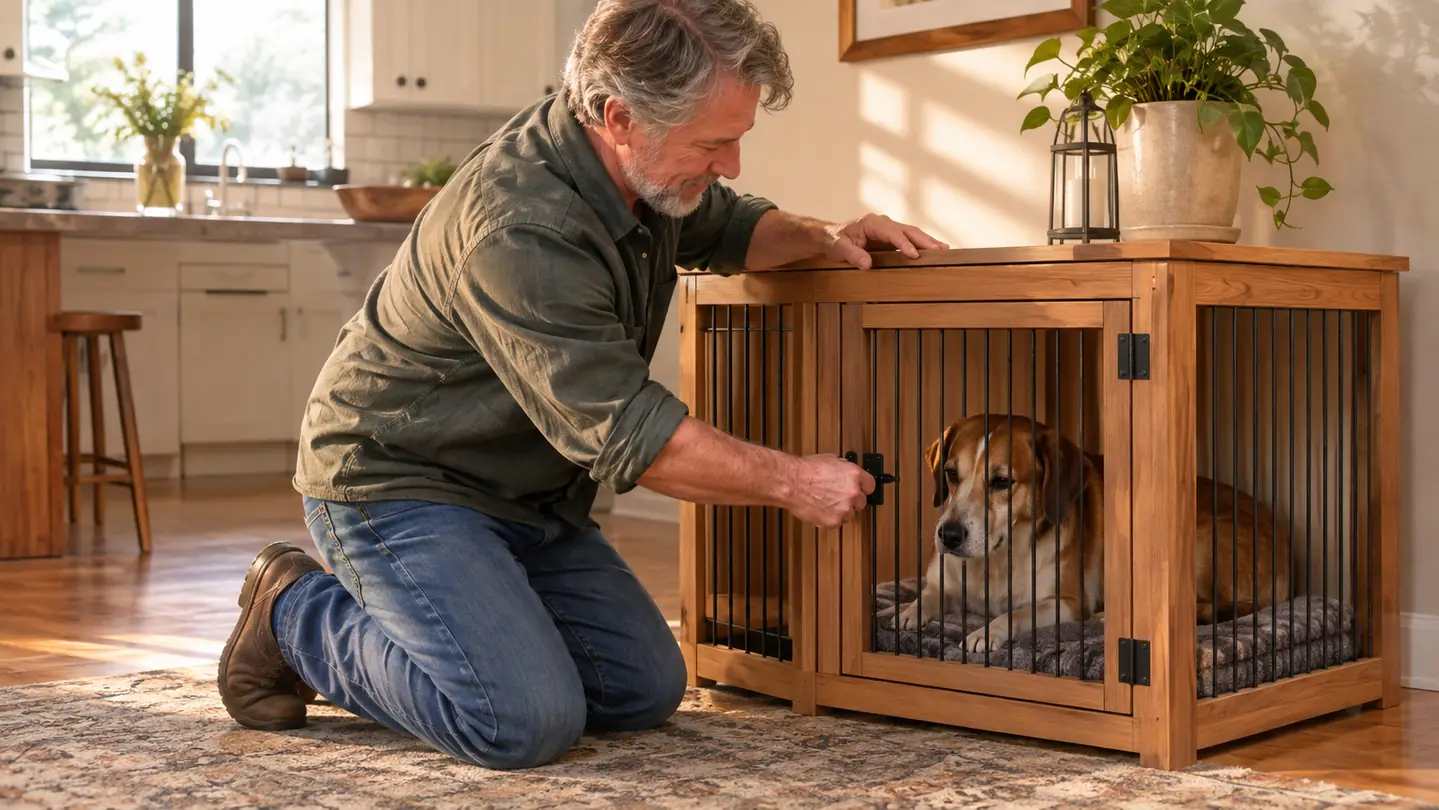
The daily routine is boring, which is the point. I open the door in the morning. Juniper puts herself in around two in the afternoon when the sun hits that patch of floor, which is the entire reason I bought the thing. I close the door when a delivery arrives, because she is friendly and loud about it. On Sundays I wipe the outside down with a damp cloth. That is the whole relationship. Six months in, nothing on it has loosened, chipped, or needed tightening.
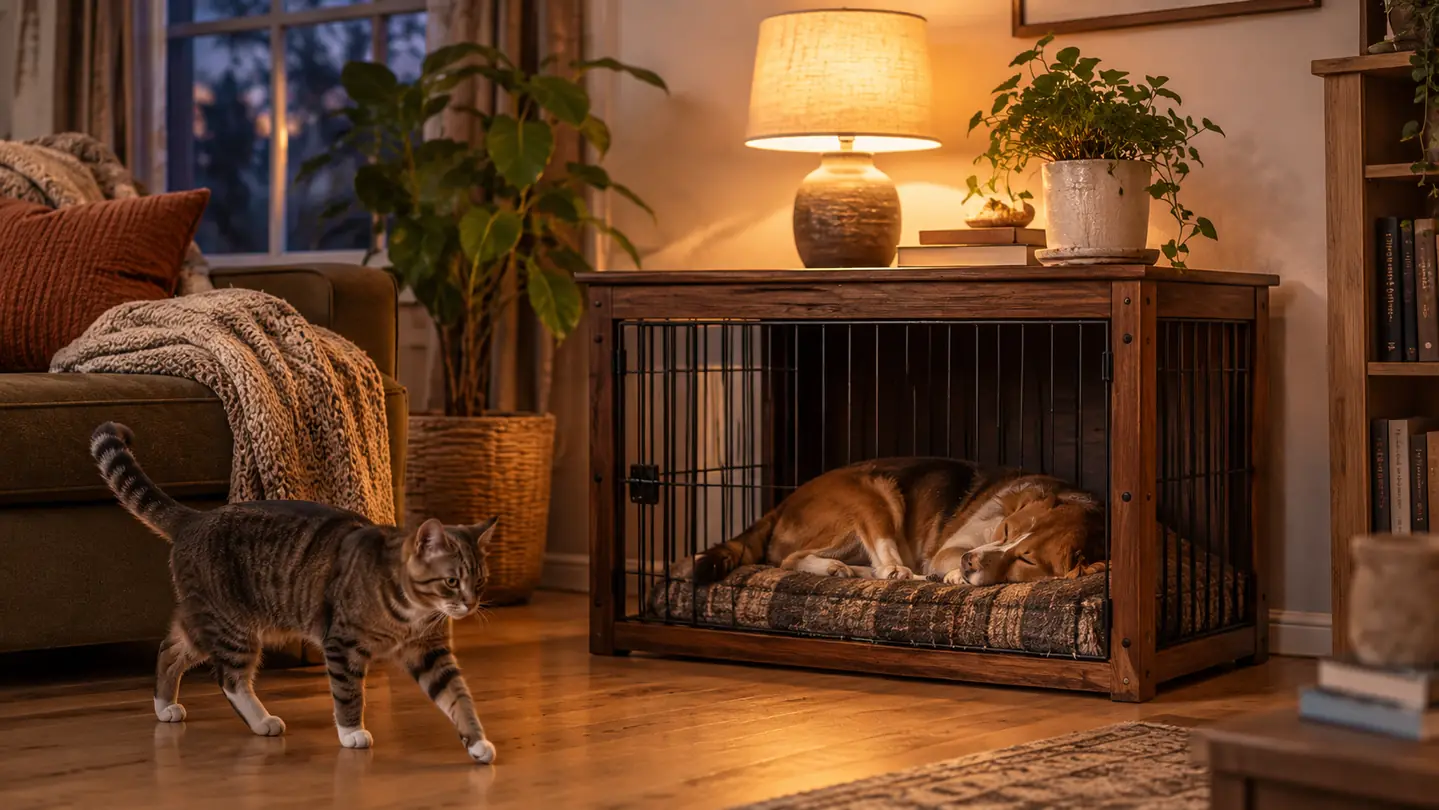
Pip, my nine-year-old cat, treats the top of it as a launch pad, which I did not plan for and cannot stop. Nine years of him scratching anything upholstered is why the linen sofa has a corner that looks like it lost a fight. He has not scratched the crate. He sits on it, usually at the worst possible moment, and looks at me. I have decided to call that a win and move on with my life.
What ECOFLEX Is and Why It Matters in a 1940s House
New Age Pet builds this out of a composite material they call ECOFLEX, and the detail that actually matters is not the name. It is that the finish is embedded in the material rather than sprayed on top of it. In a house with a dog who leans on things and a cat who lands on things, that is the difference between a piece that develops a bald patch in year two and a piece you can wipe and forget about. You cannot chip through a surface that is not a surface.
The hardware is stainless steel, which in a humid corner of western North Carolina is not a small thing. I have watched cheap brackets rust on shelving in this house inside eighteen months. Nothing on this crate has rusted, spotted, or discolored, and it sits near a window that gets condensation in January.
The rest of it is unremarkable in the way good furniture is unremarkable. It reads as a low end table. Guests have set drinks on top of it before realizing there was a dog inside, and then they crouch down and look through the slats, and then they ask me where I got it. That has happened four separate times since spring. I am not dressing that up for effect. Four times.
Guests have set their drinks on it before realizing there was a dog inside. That has happened four times since spring.
Living With It: Shedding, Scratching, and the Weekly Wipe-Down
Shedding is the tax I pay for Juniper. Her hair works into everything, including the seams of objects I did not know had seams. On this crate the hair sits on the surface and lifts with a damp microfiber cloth, and because the finish is not a coating, I am not nervous about scrubbing it. Plain water most weeks. Twice I used a mild dish soap solution on a spot near the door where she drools while she waits for me to finish whatever I am doing.
Nails are the other test. Juniper does not dig, but she does the thing dogs do at a crate door, that small scrape and pause. After months, the area just inside the door has a faint change in sheen if you get down at floor level and hold it to the light. Standing up, you cannot see it. I am telling you about a sheen change rather than letting you find one and wonder whether you got a bad unit, because you probably did not.
What I notice day to day is how much less visual noise the room has. A wire crate shows you everything at once: the tray, the blanket, the half-chewed toy, the dog, the hardware, the dust on all of it. This shows you a surface. That is honestly the whole product. It is a crate that stopped announcing itself, and in a small living room that is worth more than any single feature on the spec sheet.
The Latch, the Door, and the Calm-Dog Caveat
The listing says this crate is designed for calm, crate-trained adult dogs, and I want to underline that instead of skating past it the way I did the first time I read it. The door and the latch are built for a dog who accepts a crate. They are not built for a dog who body-checks the door for twenty minutes because someone rang the bell. If your dog has already broken out of a wire crate, this is the wrong purchase and no amount of good styling will change that.
The latch is a simple mechanism and it locks. It has not popped open on me, and Juniper has not tested it in any serious way, because she does not test things. If you have a door-worker or a determined chewer, look at a different category of crate entirely. I would rather lose the sale for this crate than have you find out the hard way on a Tuesday afternoon.
There is a second effect of solid panels that nobody warns you about. The inside is quieter and darker than wire, and Juniper settled into it faster than she ever settled into the open crate she used before. Some dogs hate that. A dog who wants to keep an eye on the room will tell you so, at volume, for about a week. You know your dog. I do not.
Fit, Assembly, and Where It Lands in a Room
The numbers, because they were the thing I most wanted when I was shopping and could not find in one place. Exterior is 29.5 inches long, 21.1 inches wide, and 25.2 inches tall. Interior is 26.77 by 17.72 by 20.87. It weighs 31.2 pounds, which is heavy enough to stay put when a dog turns around inside and light enough that I have moved it twice on my own without asking my husband for help.
Juniper is about 45 pounds and she can stand, turn, and lie flat inside it. She cannot do all three at once, and on a warm afternoon she chooses lie flat. If your dog is longer than she is tall, measure the length before you order, because length is the dimension that fails first and it fails quietly. The crate comes in four sizes from Small up to X-Large, so there is a fair chance a different size is your size. Medium is not a default, it is just what fit my dog.
Assembly took me about twenty minutes with the included hardware and one screwdriver, on the living room floor with the parts laid out on a towel. Nothing was misdrilled. Nothing wobbled. I did not have to undo a step and start over, which is a lower bar than it sounds, because flat-pack furniture and I have a history that my husband finds funny and I do not.
What I Liked
- The finish is embedded in the material, so there is no coating to chip or peel at the corners
- Stainless steel hardware has not rusted, spotted, or discolored in a humid room
- Reads as a low end table from across the room, which is the entire reason to buy it
- Latch locks, and the door has stayed aligned through months of daily opening
- Twenty-minute assembly with the hardware in the box and one screwdriver
- Ten year limited manufacturer warranty, which is unusual for pet furniture
- Wipes clean with a damp cloth, including the shed hair that collects at the base
Where It Falls Short
- Designed for calm, crate-trained adult dogs, and the listing says so plainly
- The top shows a ring if a wet glass sits on it, so use a tray or a coaster
- Medium interior is snug for a dog at the top of that range or longer than average
- Solid panels block the view, and some dogs genuinely dislike that
What I'd Change After Six Months
Two things, and neither is a dealbreaker. First, the top surface is the part every guest touches, and it will hold a faint ring if someone sets down a wet glass and wanders off. I put a small ceramic tray up there and the problem vanished, so this is a fixable complaint rather than a real one. But you should know the surface rewards a coaster, especially if you have people in your house who treat furniture as a suggestion.
Second, the interior is snug for a dog near the top of the Medium range. Juniper fits well and chooses to be in there. A dog ten pounds heavier and a couple of inches longer would be folded up like a deck chair, and I would rather you size up than spend eight months watching your dog contort. The crate is not at fault. Sizing charts in this category are written to make every dog sound like a fit.
The warranty is ten years limited, which for pet furniture is the kind of number that tells you the manufacturer expects the material to outlast a chewing phase or two. I have not had to use it, so I cannot tell you how the claim process feels. I am noting it because it is genuinely unusual here and it factored into my decision.
Who This Is For
This is for the person who has already decided the wire crate is not staying in the living room, and who wants a crate that behaves like furniture without becoming a project. It suits a calm, crate-trained adult dog in the 30 to 45 pound range, a house with decent floors and a visible corner that needs filling, and an owner who will wipe a surface once a week and call it done. If you have a cat who claims high ground, that comes free of charge. New Age Pet built a piece that guests compliment before they understand what it is, and in my experience that is rarer than it should be.
Who Should Skip It
Skip it if your dog is not crate trained, if your dog has escaped a crate before, if your dog works at doors, or if your dog is a serious chewer. Skip it if your dog is at the long end of the Medium range, and look at a larger size instead. Skip it if your dog needs to see the room while crated, because the panels are solid and that is the trade you are making for a piece that looks like furniture. And skip it if you want a crate you can fold flat and throw in the car, because this one weighs 31.2 pounds and it is going to live where you put it.
Measure your dog's length first, then pick the size that actually fits
Exterior 29.5 by 21.1 by 25.2 inches. Four sizes from Small to X-Large. Stainless steel hardware and a ten year limited warranty, for the dog who is already calm in a crate.
Amazon Check Today's Price on Amazon →