
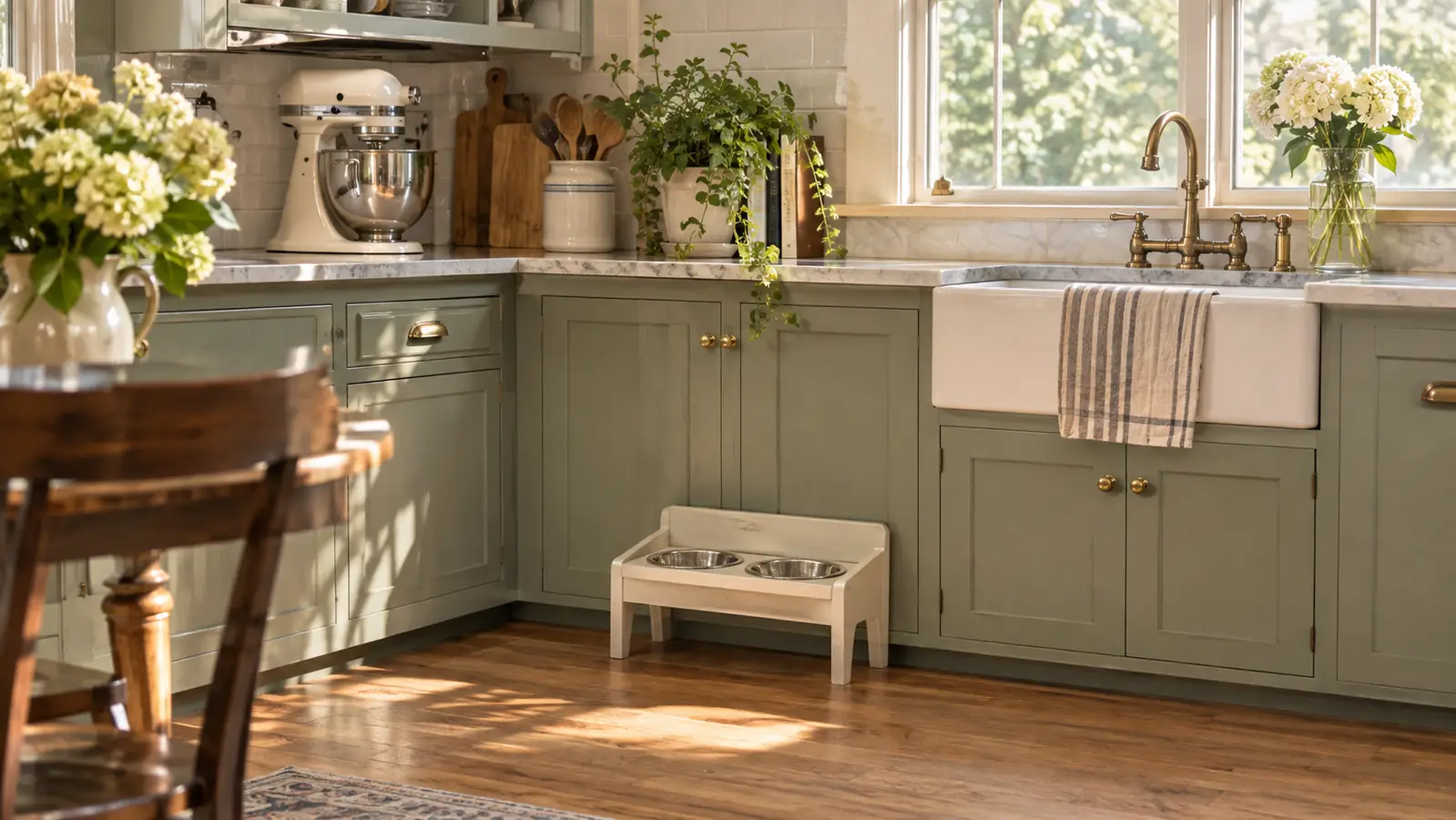
For three years the corner of my kitchen held a plastic bowl on a rubber mat, and I pretended not to see it. I have firm opinions about the light above the sink and the hardware on the cabinets. I had no opinion at all about the thing Juniper licked clean twice a day. Then a client walked through during a consult, looked down, and asked if that was the only object in the house that did not belong. It was. The bowl went to the garage that afternoon and stayed there for a week while I decided what to put in its place.
Juniper is a six-year-old mixed breed, about 45 pounds, and she sheds year round. Pip is nine and treats every upholstered surface as a scratching post he is owed. Both of them eat in the same corner of the same 1940s bungalow kitchen, which means the bowl station has to survive a dog, a cat, and a person who notices finishes. I replaced the plastic with the AHX elevated ceramic bowl set and left it in place for months, through a wet mountain winter and a pollen season that turned the porch yellow. Here is what held up, what did not, and who should not buy it.
The Quick Verdict
The first pet bowl set in my house that reads as pottery instead of equipment. The 320 ml bowls are the real tradeoff, not the finish.
Amazon Check Today's Price →The corner of the kitchen you stop noticing
Two raised ceramic bowls in a non-slip stand with a splash guard at the back. It holds still while a dog eats, and it looks like something you chose on purpose.
Amazon Check Today's Price on Amazon →How I've Used It
I did not stage a photo shoot for this. The stand went on the same tile the plastic mat covered, beside the cabinet run, and it never moved again except when I wiped under it. Food goes in one bowl and water in the other. Each bowl lifts straight up out of the stand, so washing is a lift and a rinse rather than unhooking anything or carrying a whole assembly to the sink. I have washed both bowls by hand several hundred times at this point, which is the least interesting sentence in this review and also the most accurate description of ownership.
The reason I kept using it is not the look, though the look is why I bought it. It is that Juniper stopped doing the thing she used to do, where she pushed the bowl across the floor with her nose while she ate. The stand has a non-slip base and the bowls sit down inside it, so the whole assembly stays where you put it. On tile. On a slightly uneven 1940s floor. Through a dog who eats like she is being timed.
Pip took longer to convert. He is a cat who prefers the bathroom tap and has never once respected a bowl he could tip. Within a week he was drinking from the raised bowl without complaint, largely because the ceramic is heavier than the plastic it replaced and the bowl sits recessed rather than balanced on top of something. He still checks the tap. But he uses the stand, and he has not knocked it over.
The Numbers, and Why the Height Matters
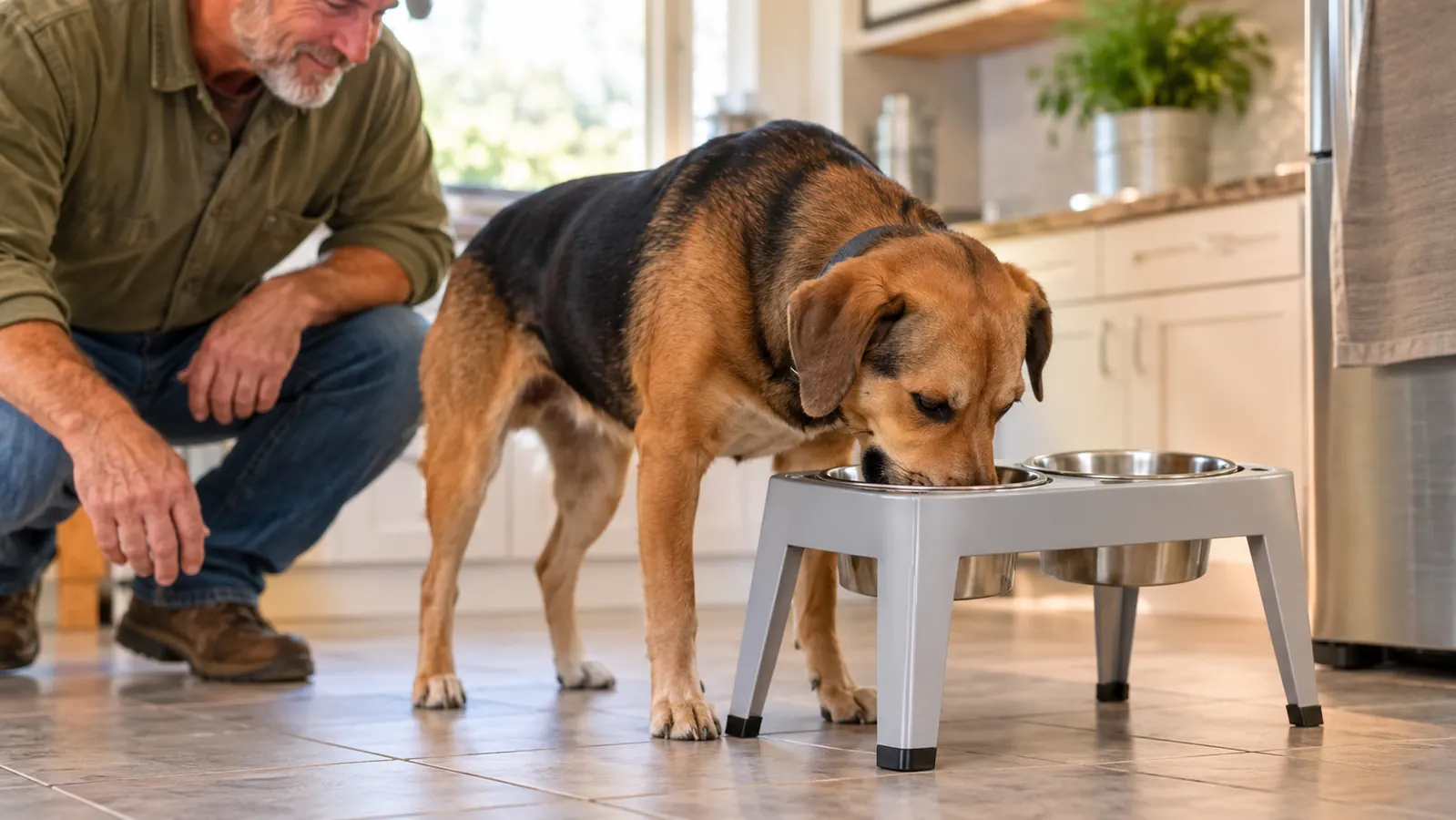
The whole unit is 14.5 inches long, 7.5 inches wide and 4.4 inches tall, and it weighs about a pound. Two ceramic bowls, 320 ml each, which is a little over a cup and a quarter per side. That is the entire specification, and the specification is where you find out whether this is your product or not.
The AHX listing is upfront about the size class, and I would rather repeat it than have you find out at the sink. For Pip, 320 ml is generous. A cat drinks maybe four to six ounces a day. For Juniper at 45 pounds, 320 ml of water is a small pour, and I refill her side twice on a normal day and three times when it is hot. That is the honest cost of the elevated design. The 4.4 inch height does not eliminate bending for a 45 pound dog. It reduces it, and she eats with a straighter back than she used to, which is the most I can claim without a vet in the room.
Where the height lands exactly right is a cat, a rabbit, or a dog under about 20 pounds. A beagle, a dachshund, a shih tzu, anything in that range, and the rim sits at a comfortable reach so the animal does not drop its head to the floor to eat. If your dog is a retriever or a shepherd, you want something taller and much larger, and this is not it. That is not a flaw in the set. It is a size class, and the listing tells you which one you are in.
The Splash Guard Is Why I Stopped Keeping a Rag Under It
The back wall of the stand rises above the bowl line, and that lip catches the water Pip throws around when he drinks. Before this, there was a folded rag on the tile behind the water bowl at all times, and I swapped it out every couple of days. Months in, the rag is still in the drawer. The painted wall behind the station stayed dry through the winter, which has never been true of any bowl arrangement I have owned.
What the guard does not do is catch splash from the front or the sides. Juniper still leaves a ring of water on the tile in front of her bowl after a big drink, and I still wipe it up. The guard solves the problem that actually bothered me, which was water climbing the wall behind the station. It does not solve the floor. Anyone telling you a bowl set eliminates floor mess is describing a different product.
The stand is open underneath, and that matters more than it sounds. There are no closed tubes or hidden cavities for kibble dust and hair to collect in. A cloth goes through it in one pass. In a house with a shedding dog, that is the difference between a station you clean weekly and a station you quietly stop cleaning around.
What Months of Daily Use Did to the Finish
The AHX bowls are high-fired ceramic, and the listing notes they are free of lead. What I can speak to is the surface. After months of a dog's tongue, a cat's paws, daily hand washing, and the general abrasion of a working kitchen, there is no crazing and no chipping at the rims. I have knocked a bowl against the faucet more than once and winced both times. So far the ceramic has won.
The glaze has stayed even, which surprised me. Ceramic that sits in water constantly can go dull around the waterline. The water bowl here shows nothing you would notice unless you were looking for it with a light at an angle, and I was, because that is the kind of thing I notice. The stand and the bowls are finished differently enough that the set reads as a piece of pottery rather than pet equipment, and that contrast is doing most of the visual work.
The stand has picked up nothing worse than a faint dulling where Pip's paws land when he stretches up to check the water. I wiped it with a damp cloth and it went away. No peeling edge, no rubber foot that came loose, no wobble after months on a floor that is not perfectly level. The non-slip base is still doing what it says, which is the part of a product like this that usually fails first and quietest. There is a one year manufacturer warranty on the listing, and I have not needed it.
One honest note on material. Ceramic breaks. A bowl dropped on tile at the wrong angle is going to break, and no amount of listing copy changes that. In months of daily handling I have not dropped one hard enough to test the question, and I handle them the way I handle my own dishes. If you want a bowl you can toss into a sink full of pans without thinking, that is a different material and a different review.
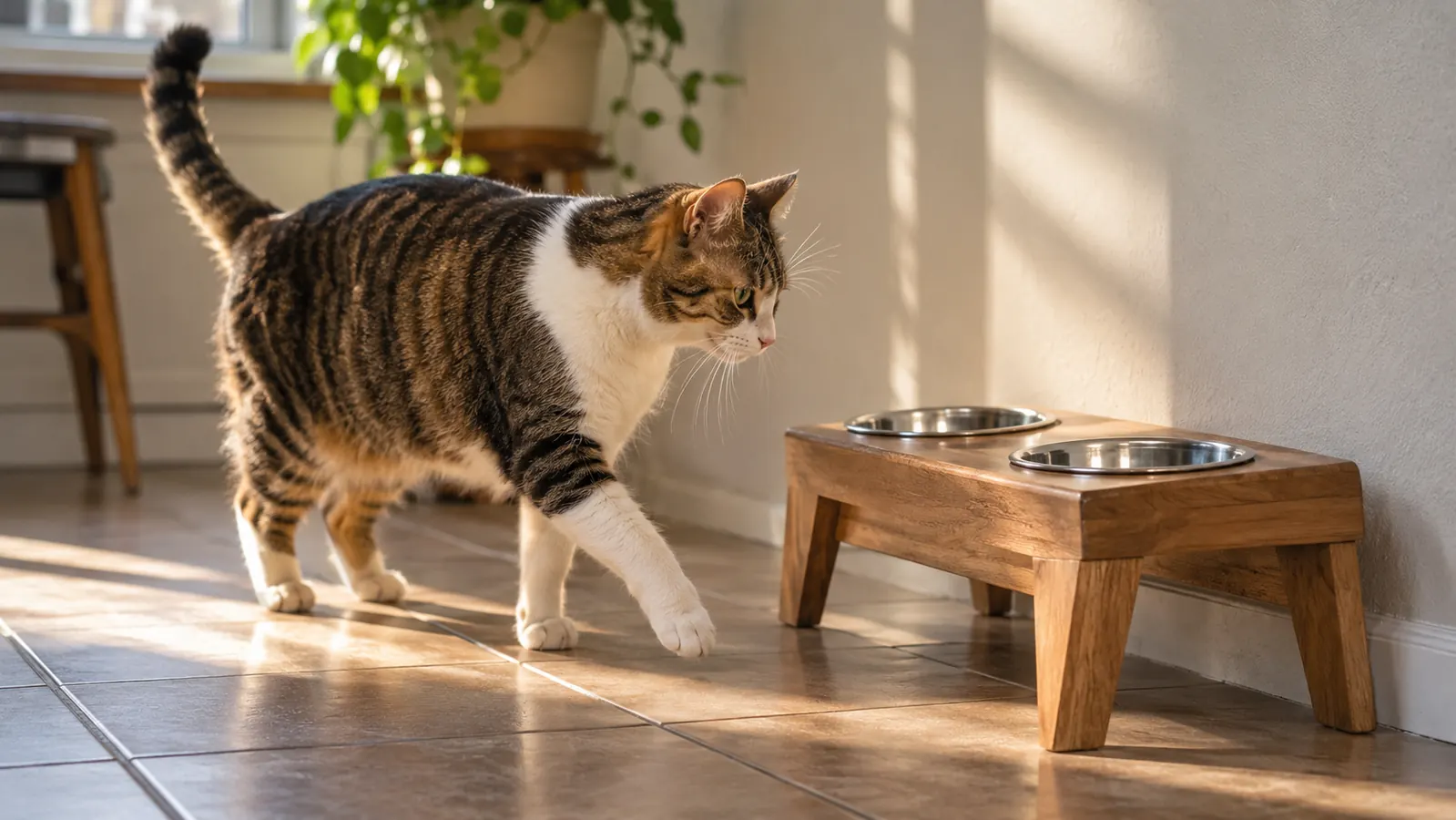
How It Sits in a Real Room
My kitchen has light oak floors, a cream linen sofa three feet away in the living room, and a cabinet run painted a soft green that I chose years ago and have not regretted. The old plastic bowl sat against that cabinet run and read as a mistake. The stand reads as a low piece of pottery, roughly the height of a stack of two books, and it settles into the corner the way a good object does. Two separate guests have asked where it came from. Nobody ever asked about the plastic.
The footprint helps. At 14.5 inches long it is not a piece of furniture, and it tucks under the lip of a counter overhang without crowding the walkway. If your kitchen is small, measure the corner before you order, because 14.5 by 7.5 is wider than one bowl and a mat, and the stand wants a little runway.
One thing I did not anticipate: the height changes the sightline. A bowl on the floor sits below eye level and is easy to ignore. A bowl on a 4.4 inch stand catches the light from the window over the sink, and you see it the moment you walk in. That cuts both ways. It looks better, and it is far more visible when it is empty or when the water has gone warm. I refill more often than I used to, which is probably good for both animals.
A styling note, since that was the job. Do not put anything on top of the splash guard. Do not put a mat under the stand, because the non-slip base already does the job and a mat reintroduces the exact rubber rectangle you were trying to get rid of. Set it against a wall or a cabinet side so the guard has something to protect, and leave the floor in front of it bare so you can wipe it in one motion.
What I Liked
- Two 320 ml ceramic bowls in one stand, so feeding and refilling is a single trip
- The raised back wall keeps the painted wall behind the water bowl dry
- Non-slip base holds on tile and stops the bowl-pushing that drove me up the wall
- High-fired ceramic with no chips or crazing after months of daily hand washing
- Reads as pottery in a finished kitchen instead of pet equipment
Where It Falls Short
- 320 ml per bowl is small for a dog much over 20 to 25 pounds
- Splash guard covers the back only, the floor in front still gets wet
- Ceramic will break if dropped, that is the material
- No dishwasher guidance on the listing, so I hand wash both bowls
Months in, the wall behind the water bowl was still dry. No bowl arrangement in my house has ever managed that.
Who This Is For
This is for the person with a cat, or a small dog, or one of each, whose kitchen is visible from the living room and who is tired of looking at a rubber mat. It suits a household where the feeding station sits on tile or hardwood in a room you actually use, because the whole argument for ceramic in a raised stand is that it stops being an eyesore. It suits a cat owner whose cat splashes the baseboard and leaves a wet ring. And it suits anyone who has quietly moved the pet bowls out of sight when guests arrive, which I did for three years without ever admitting it out loud.
Who Should Skip It
If you have a large dog, skip it. Juniper is 45 pounds and she sits at the very top of what this set handles comfortably. A 70 pound dog would be drinking from a bowl that needs refilling constantly and eating with its head still angled down. Skip it if you have two dogs eating at the same time, because two 320 ml bowls is one meal for one medium dog and nothing more. Skip it if loading bowls into a dishwasher matters to you, since the listing makes no claim there and I did not test it. And skip it if the bowl station lives in a laundry room where nobody sees it, because the look is the entire argument and you would not be using it. AHX built this for a specific size class, a small one, and the set is genuinely good inside that class rather than stretched to cover everyone.
If there is one corner of your kitchen you avoid looking at
Two ceramic bowls, a raised non-slip stand, a splash guard at the back, and a finish that survives a shedding dog and a curious cat. Months in, mine still looks like something I chose.
Amazon Check Today's Price on Amazon →