
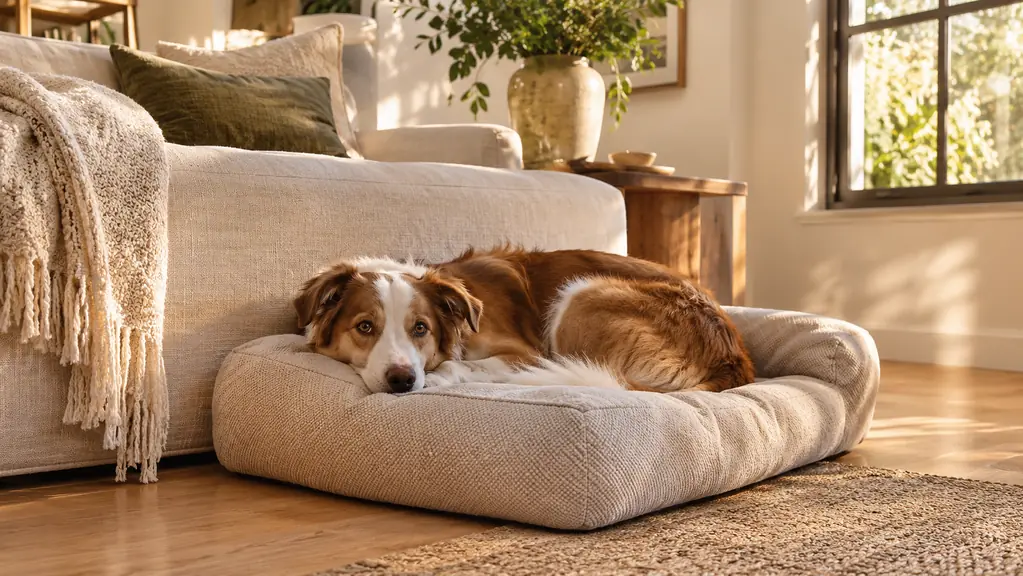
Juniper has a spot in the living room where the afternoon sun lands on the light oak floor, and for two years that spot was her bed. Not a dog bed. The floor. I bought her three beds and every one of them drifted to the guest room, where they sat looking like a decision I had made in public and regretted in private. She is a 6-year-old mixed breed, about 45 pounds, and she sheds year round, so a bed in the living room is not only a style question. It is also a lint roller.
What changed my mind was treating the purchase like furniture instead of like pet gear. A dog bed sits in the room you actually live in. It eats floor space you were using for something else. It has to survive a 45-pound animal with opinions and a cat who tests every seam in the house. Once I started evaluating beds the way I evaluate a side table, the choices got obvious fast. The one that finally stayed in my living room is the Bedsure orthopedic dog bed, and the reason it stayed is not that it is the most beautiful object I own. It is that I measured twice before I bought once.
The bed that finally stopped migrating to the guest room
Bedsure orthopedic dog bed, large sizing at 38 inches long, 28 inches wide and 6.5 inches thick. Egg-crate foam core, four bolsters, removable waterproof cover, washable.
Amazon Check today's price on Amazon →Step 1: Measure the dog stretched out, not curled up
Every size chart assumes a curl. Dogs do not always curl. Juniper curls when it is cold and sprawls when it is not, and a sprawled 45-pound dog takes up considerably more floor than a curled one. So I put her in the hallway with a treat at the far end and ran a soft tape from the base of her tail to the tip of her front paws. She measured about 34 inches long and roughly 22 inches across the shoulders.
Then I added room. Not a lot, because a bed that is too big defeats the point of a bolster, but enough that she could stretch out without hanging off the edge. The Bedsure large is 38 inches long, 28 inches wide and 6.5 inches thick, which left her about four inches of slack at each end. That is the right amount. A bed she can just barely fit inside is a bed she will abandon for the floor by the second night.
One thing catches people out. A four-sided bolster is comfortable, but the bolsters eat into the flat sleeping area. Those 38 by 28 inches are the outside of the bed, not the inside. If your dog is at the very top of a size range, or if you have a dog who sleeps flat like a rug, size up rather than trusting the word large on the listing.
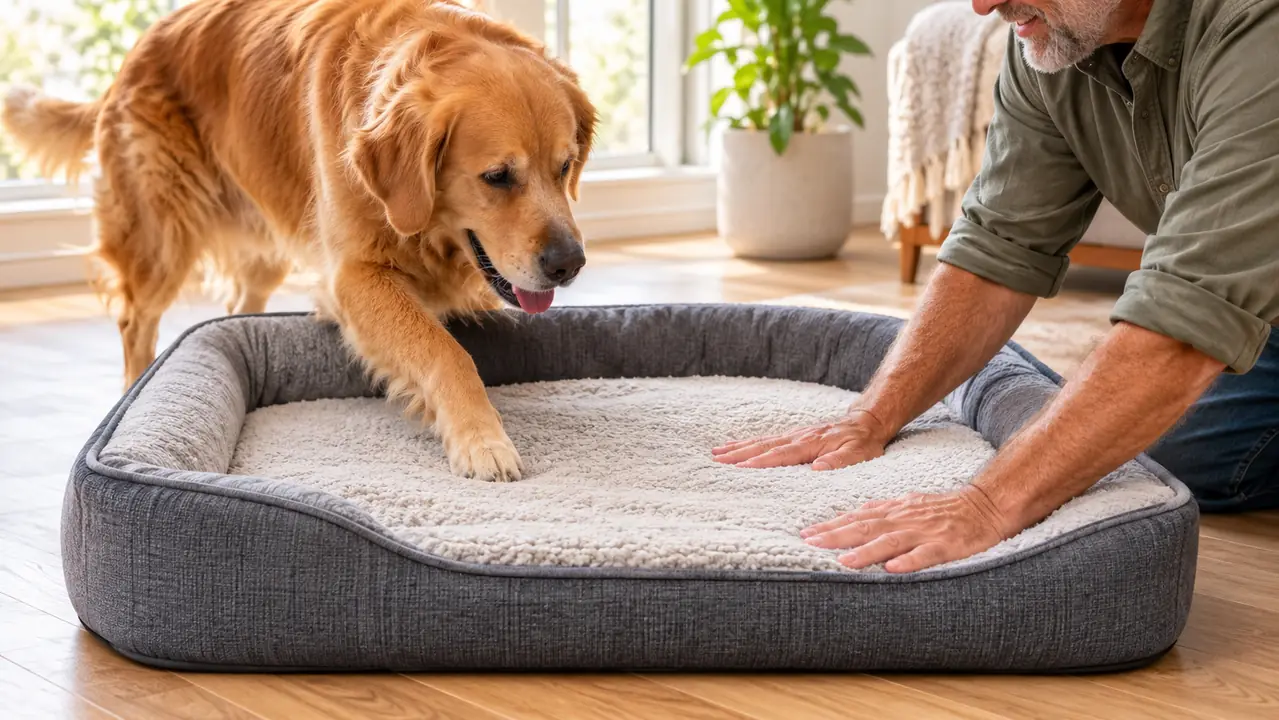
Step 2: Tape the footprint on the floor before you buy anything
The single most useful thing I did was lay painter's tape on the oak in a 38 by 28 rectangle and leave it there for three days. That is a little smaller than a small armchair, and it is more floor than most people picture when they order a large bed online. Walking past that rectangle for three days told me more than any photo on a product page.
Placement matters as much as size. Put the bed against something, a wall or the arm of the sofa, because dogs like a side to their back and the room reads calmer when the bed is anchored. Keep it out of the main traffic lane between the kitchen and the front door, or you will be stepping over it at 6 a.m. in the dark, which is how beds end up in the guest room. In my living room the rectangle landed at the end of the sofa, angled slightly, where the sun arrives in the afternoon and where nobody walks.
Two more checks before you commit. Look at what the bed will sit against, because a tall bolster in front of a low radiator or a floor vent is a problem you cannot see in a product photo. And look at the light. A bed that spends the day in direct sun through a window will fade and hold heat, and a dog will find it less appealing than the shaded floor two feet away. Move the tape, not the dog.
Step 3: Match the cover to the upholstery, not to the pet aisle
Most dog beds are designed to look like dog beds, which is exactly why they look wrong in a room with a cream linen sofa and a wool rug. My rule is that the bed should read as one more piece of upholstery. That usually means a solid or a subtle texture, a tone that repeats something already in the room, and no cartoon prints, no paw motifs, no shiny trim and no contrast piping that draws the eye to the floor.
The Bedsure cover is the part you actually look at, and because it is removable you are not locked into a decision forever. That matters more than people expect. If you change the rug or repaint the hallway, a cover swap is a far smaller commitment than a new bed, and it is a much smaller job than reupholstering a chair. I treat the cover the way I treat a throw pillow, which is to say I expect to change my mind.
There is an honest tradeoff in this step. A quiet, neutral cover shows dirt. It shows fur. It shows the muddy paw print from a wet Tuesday. I would rather have a bed that looks right in the room and needs washing than a bed that hides everything and looks like a crate liner. If you feel the opposite, that is a legitimate choice, and the dog does not have an opinion either way.
Step 4: Read the foam spec before you read the pattern
A dog bed is foam inside a bag. The foam decides whether the bed is still supportive in a year, and the bag decides whether you can live with it in your living room. So I read the foam line before I look at anything else. This bed uses polyurethane foam cut in an egg-crate profile, with a CertiPUR-US certification for the foam and a STANDARD 100 by OEKO-TEX certification, 24.HCN.46956, for the materials. Those two things get checked first because they are expensive to fix later and impossible to fix after the return window closes.
The 6.5-inch thickness is the number I would pay attention to if you have an older dog or a dog who is stiff in the morning. Egg-crate foam spreads weight instead of letting hips and elbows press straight through to the floor, which is the entire point of the orthopedic label. It is not a memory foam mattress and it is not a medical device. It is a thick, resilient pad, and for a middle-aged 45-pound dog it has held its shape through a full year of daily use.
The four-sided bolster deserves its own note, because it changes how the bed feels to a nervous sleeper. Juniper sleeps with her chin over one bolster and her back against the other, which is the same reason she likes the corner of the sofa. If your dog is a sprawler who sleeps flat out in the middle of the floor, the bolsters will be in the way, and a flat mat is the honest answer. Buy for the dog you have, not the dog in the photo.
Step 5: Plan the wash before you need it
Every bed looks fine on day one. The test is day ninety, after shedding season and a run of wet walks. The cover on this bed comes off, and the cover and the waterproof layer are both made to be cleaned. I run a lint roller over it twice a week and I wash the cover on a schedule rather than on an emergency basis, because a bed that only gets washed after a mess is a bed that smells like the mess.
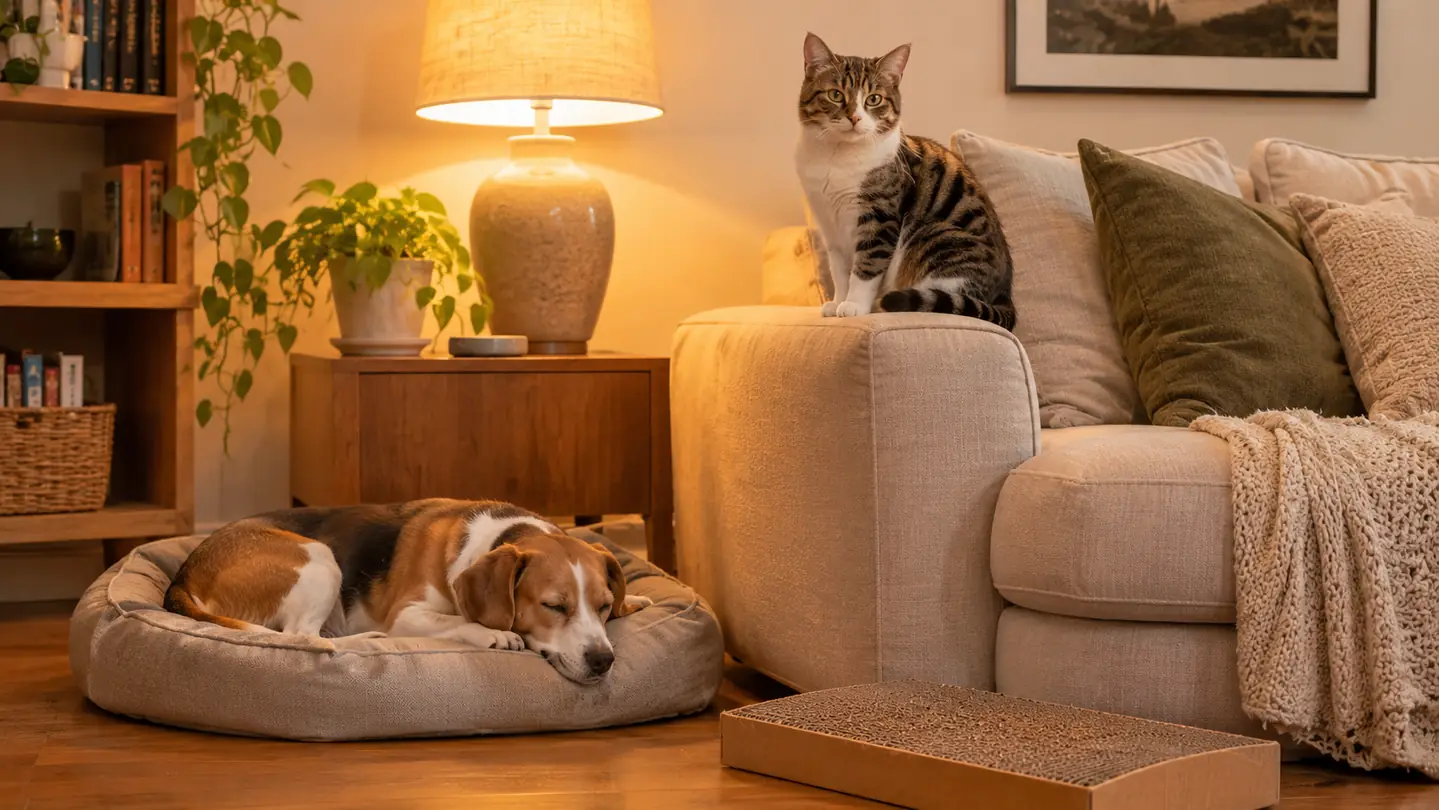
Plan for the cat as well. Pip is 9, and he will scratch anything upholstered if he is not offered a better option, and a foam bed with a removable cover is precisely the kind of thing he notices. I keep a cardboard scratcher within three feet of the bed. That is not a dog bed problem, it is a living room problem, and solving it on the furniture side is much easier than solving it later with a repair.
The 6.77-pound weight is worth knowing about too, because it means the bed can be dragged from the sunbeam into the shade by the dog herself. Juniper moves hers about two feet a day. I decided that was charming rather than annoying, and I have mostly stuck to that.
38 inches long, 28 wide, 6.5 inches of egg-crate foam, four bolsters and a cover that comes off in one piece. That is the entire argument, and it is enough.
What Else Helps
A few small things separate a bed that looks intentional from a Bedsure bed that looks like pet gear in a nice room. The first is a thin mat or a scrap of non-slip rug pad underneath. Even on oak, a bed that slides across the floor reads as clutter, and a pad keeps it where you put it.
The second is a spare cover, or at minimum a wash cycle you can actually live with. Washing on a weekday morning and having the bed back together by the afternoon is the difference between a routine and a crisis. The third is placement. A bed in the middle of open floor is furniture nobody can walk around. A bed tucked against a wall, at the end of a sofa, or under a window reads as part of the room and stops being something you apologize for.
The last thing I would tell anyone is to give it two weeks. Juniper ignored hers for three days and then slept in it for eleven hours straight on a cold Thursday. Dogs are conservative about new furniture, and a bed that is the right size in the right place will get adopted on its own timeline. No amount of coaxing, treat-baiting or carrying the dog over to it will speed that up, and a little patience will.
Measure the floor, tape the rectangle, then bring this one home
38 by 28 inches with 6.5 inches of egg-crate foam, four bolsters, a removable waterproof cover and washable materials. Large sizing, indoor use, CertiPUR-US foam.
Amazon Check today's price on Amazon →