

Dog hair does not rest on upholstery. It weaves in. I learned that the slow way, across two years of a 45-pound mixed breed named Juniper sleeping in the same sun patch on my cream linen sofa, and by the time I pulled the cushions off to clean underneath, the fabric had absorbed enough undercoat that no vacuum attachment could reach it. The claw damage was worse. Linen is a loose weave, and Pip, my nine-year-old cat, had decided the sofa arm was the finest scratching post in the house and treated it accordingly.
So I did what any former interior stylist does when a room stops behaving: I took the problem apart. Protecting a couch from a shedding dog and a determined cat is not one decision. It is five decisions, in a specific order, and getting the order wrong is how people end up with a cover that pills in a month or bunches every time somebody sits down. Getting it right keeps the sofa underneath close to new for years. The cover I landed on after a genuinely embarrassing number of returns is the Easy-Going reversible couch cover, and here is exactly how I use it.
Measure your seat width first, then buy the cover that actually fits
The Easy-Going reversible couch cover is sized for seat widths up to 66 inches, with a three-layer quilted polyester face that takes nails far better than a stretchy slipcover. Check your seat measurement against the size guide before anything else.
Amazon Check Today's Price on Amazon →Step 1: Measure seat width, not the whole sofa
The most common reason a couch cover looks terrible in a living room is that it was bought for the wrong dimension. These covers are sized by seat width, which means the distance across the sofa from the inside face of one arm to the inside face of the other. Not the total width of the frame. Not the height of the back. Seat width. Every return I have ever made on a textile came down to this one measurement, and I have made a few.
I measured my sofa three times because I did not trust the first number. I sat on the floor, ran the tape from the inside face of the left arm to the inside face of the right arm, and wrote the result on the back of a paint chip so it would not vanish into my phone. The Easy-Going cover in the large size is rated for seat widths up to 66 inches, and my sofa came in under that with a few inches to spare. That slack is the point. A cover that sits exactly at the limit has nothing left to tuck.
While the tape is out, note two more things. Whether your cushions are attached to the frame or loose, because a three-cushion sofa with loose cushions moves differently than one solid piece. And whether your arms are wide and padded or narrow and straight, because that changes how much fabric hangs down each side. Write both down, then compare them against the measuring guide image on the listing before you order anything.
Step 2: Choose a fabric that survives claws, not one that hides them
There is an entire category of couch cover made from thin, stretchy jersey. It photographs beautifully and it lasts about six weeks in a house with a cat. A single claw catches one thread, the thread pulls a run, and the run becomes a hole at the exact spot where the couch gets used most. I have thrown two of those away. Material matters more than pattern, and it matters more than whatever the product photo is doing.
The Easy-Going cover is a three-layer quilted polyester with a microfiber face. The three layers are the part that matters here. Quilting gives the surface a little loft, so a claw dragging across it meets a soft, dense pile instead of a taut weave it can snag and rip. The polyester is colorfast and water resistant, which handles the other half of the problem: the knocked-over water bowl, the muddy paw, the coffee that goes over the arm because someone was gesturing while telling a story.
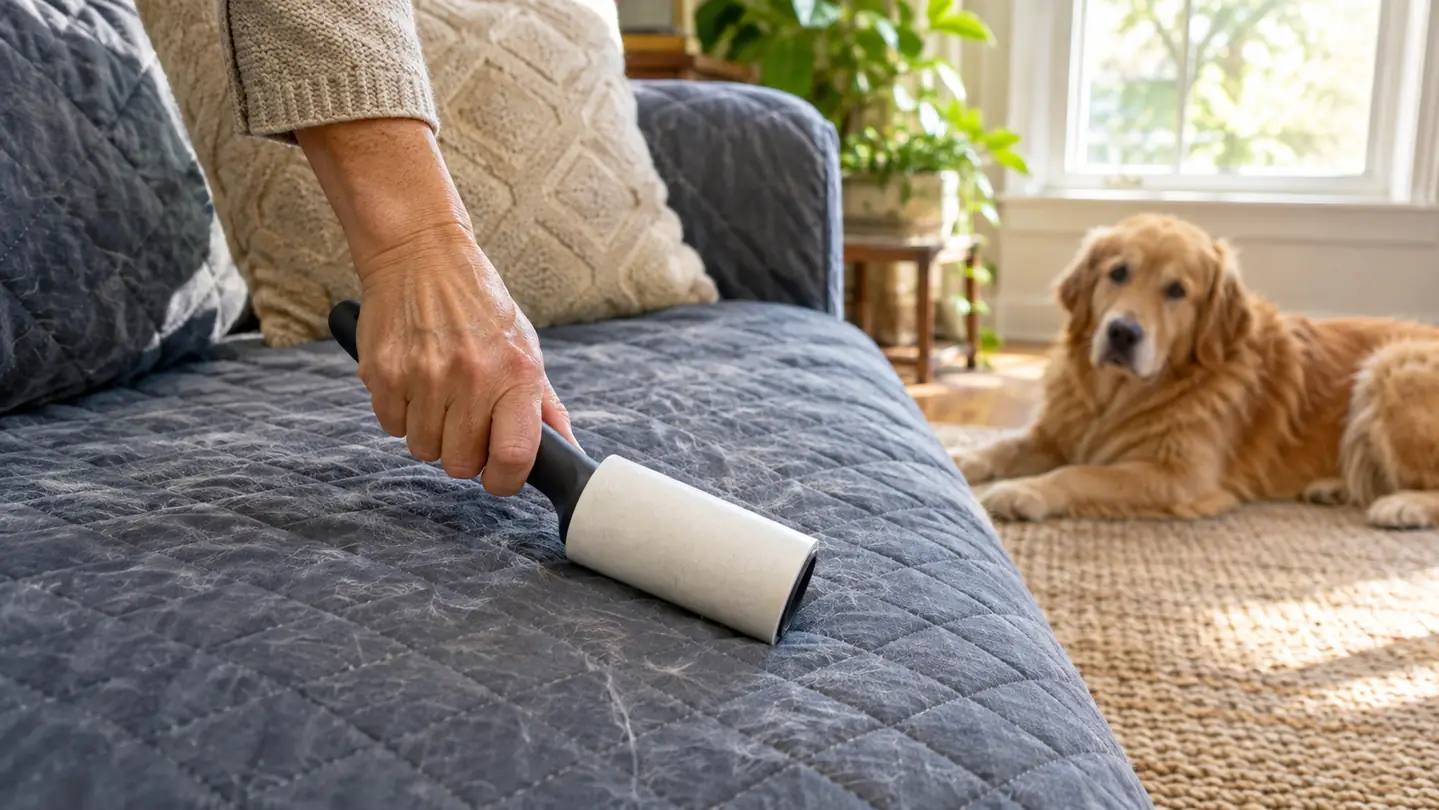
What I did not expect was how much easier the hair comes off. On bare linen I was fighting the fabric itself, pressing down and dragging and still leaving a haze behind. On the quilted polyester most of the shedding sits near the surface and lifts with a damp rubber glove or a lint roller in under a minute. That one change took my vacuuming from twice a week down to once, and I will take that trade every time.
Step 3: Drape it, tuck it, and tie it down
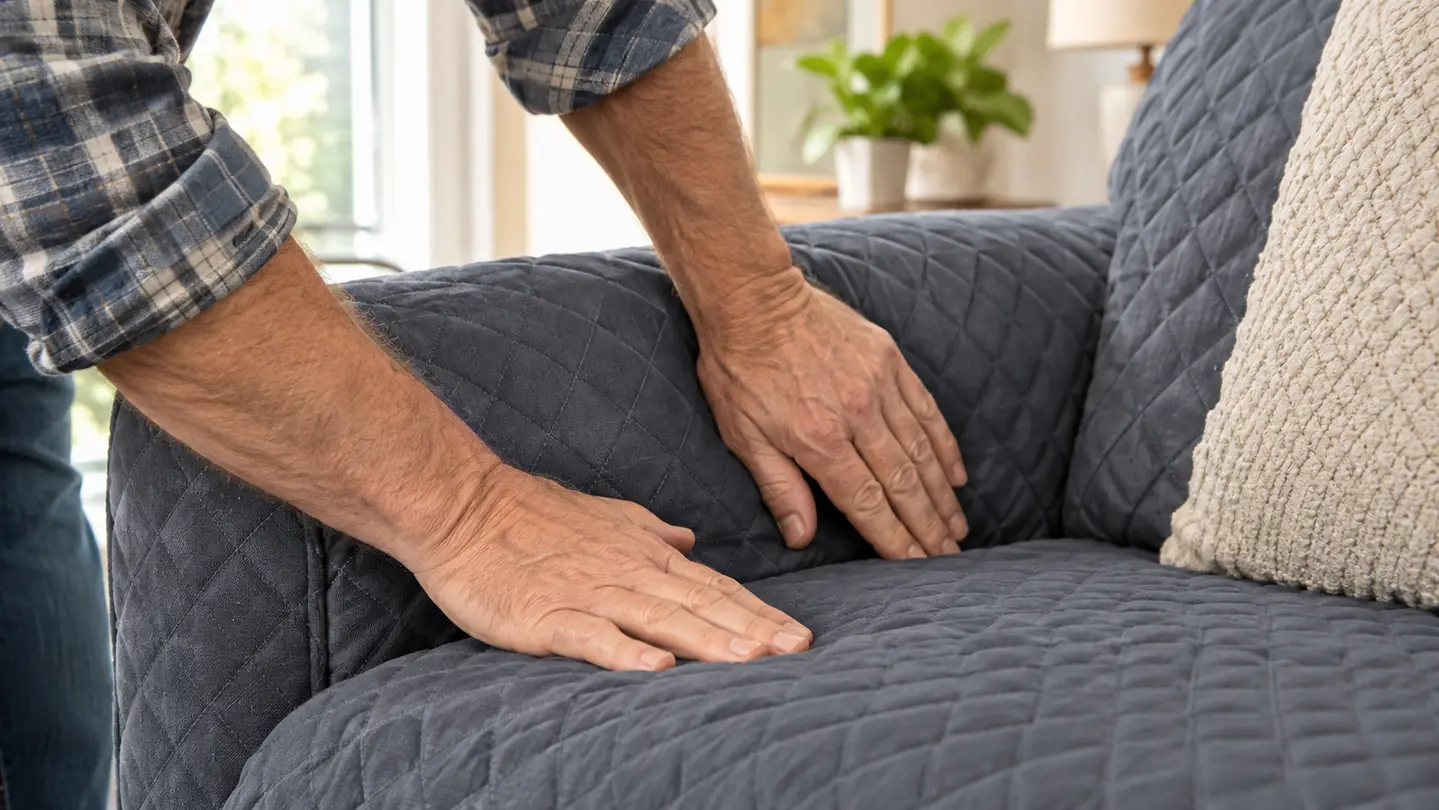
Installation is not difficult, but it is not nothing either, and how you do it decides whether the cover looks tailored or looks like a sheet that came off a clothesline. You drape the cover over the sofa, then tuck the extra fabric down into the creases between seat and back and between seat and arms. The tuck is what holds the shape. Skip it and the whole thing slides forward every time somebody stands up.
Work from the back forward. Lay the cover so the back panel hangs evenly on both sides, tuck the back crease first, then the two side creases, then the front. Use the flat of your hand rather than your fingertips, and if the gap is tight, a dull wooden spoon or a plastic ruler gets the last inch down without stretching the fabric. Take thirty seconds to check that the quilted lines run straight across the seat. They will not stay perfect, but starting straight helps.
The cover has ties, and they are worth using. Knot them behind the sofa or under the back edge where nobody sees them, rather than at the front where they become a chew toy for a bored dog. On a three-cushion sofa I also push a little fabric into the seams between cushions. That small habit is what keeps everything from shifting when Juniper does her three-turn circle before she lies down, which she does every single time.
Step 4: Give the cat a better target than the sofa arm
A cover protects the sofa from claws. It does not train the cat. Pip is nine and thoroughly set in his ways, and the honest truth is that no fabric on earth will stop a determined cat from scratching it if there is nothing else on offer. What stopped him was not the cover at all. It was a better option placed within reach of the arm he had already chosen.
I put a tall sisal post at the end of the sofa, close enough that he could stretch to full length from a standing position without stepping away. I rubbed a little catnip into the top of it. He used it within the week. I also trim his front nails about every ten days, which does not stop scratching but takes the sharpest point off the end. Between the post and the trim, the cover has held up better than I expected, and I am not a person who says that lightly about anything a cat has touched.
The same logic works on the dog side. Juniper's nails click on the oak floor, and that click is the sound of a nail that needs attention. A monthly trim and a quick pass with a file take the edge off and remove the main source of punctures and pulls. Ten minutes of work extends the life of every fabric surface in the house, including the one you are trying to protect.
Step 5: Build a wash routine you will actually keep
A cover you are afraid to wash is a cover that gets dirty and stays dirty. This one is machine washable, which is the main reason I chose it over the alternatives I looked at, but the details are what keep it looking new. Wash at around 30 degrees Celsius, use a mild detergent, and do not bleach. The colorfast finish and the quilted structure both break down quickly with chlorine.
My routine is every two weeks during heavy shedding and once a month the rest of the year, plus immediately after anything wet. Before it goes in the machine, I shake it out over the porch rail and run a rubber glove across the surface to lift the loose hair. That step is not optional. A washer full of dog hair becomes a washer full of wet dog hair, and you will find it stuck to the next three loads. Tie the cover closed, wash it, then tumble on low or hang it.
One more habit that makes a real difference over a year: rotate the cover. It is reversible, so flipping it gives the fabric a rest and evens out the wear. The cushion your dog favors will always take more abuse than the one nobody sits on, so swapping the cover end to end every few washes keeps the whole thing looking consistent instead of developing one worn patch where the sun lands.
Quilting gives the surface a little loft, so a claw meets a soft, dense pile instead of a taut weave it can snag. That is the whole reason the cover survived Pip.
What Else Helps
Two smaller things I would do again. The first is a washable throw blanket on the one cushion Juniper has claimed. It catches most of the hair, it goes in the wash with the towels, and it buys extra time between full cover washes. It also looks intentional, which matters in a room you actually want to sit in rather than a room that has been surrendered to the animals.
The second is a handheld vacuum with a rubber nozzle, kept in the hall closet. Thirty seconds over the cover before guests arrive beats a twenty-minute fight with the full-size vacuum, and being able to do it quickly is the difference between keeping up with the hair and giving up on it entirely. Convenience is not a small variable in a cleaning routine. It is the whole variable.
One thing I would skip: fabric protector sprays. The cover already has a water resistant finish, and adding a spray on top mostly makes the quilted texture feel stiff. Wash it on schedule instead, and put that effort toward a second throw blanket so one can be in the laundry while the other is on the couch.
The cover that has sat on my sofa for two years and still looks like a cover
Seat width up to 66 inches, three-layer quilted polyester, reversible, machine washable at around 30 degrees Celsius. Measure your seat before you order and the fit takes care of itself.
Amazon See Today's Price on the Easy-Going Cover →