
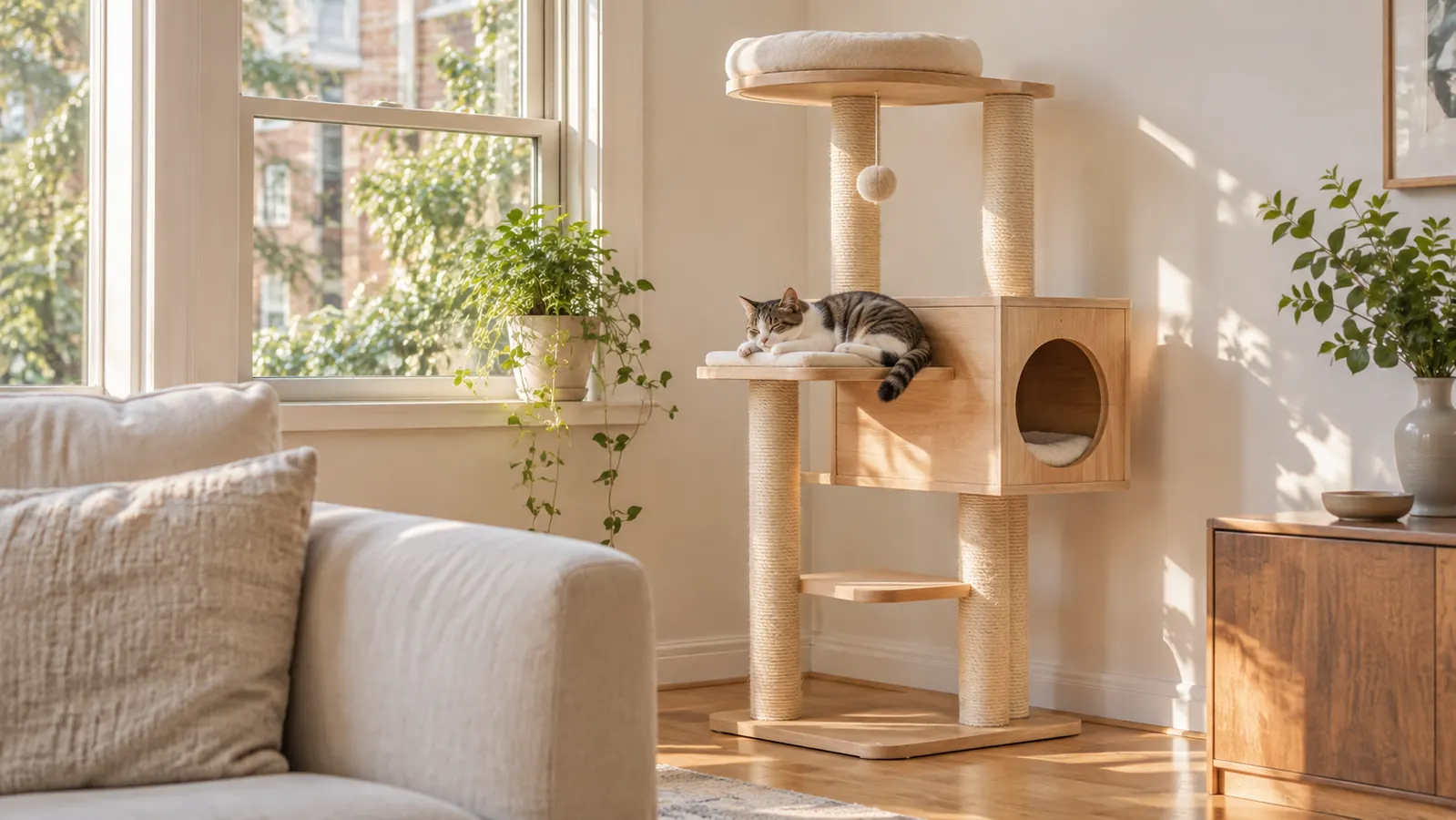
When I moved the VESPER Cat Tree into the corner of my living room, Pip ignored it for two days. On the third morning I found him asleep inside the cube, one paw dangling out of a side opening, and I understood I had finally bought something my cat preferred to my sofa. That was roughly five months ago. He has slept in it every day since.
I live in a 1940s bungalow in Asheville with light oak floors and a cream linen sofa that Pip has been slowly ruining since he was a kitten. He is nine now. Juniper, my six-year-old mixed breed, is about 45 pounds, sheds year round, and considers the sun patch on the rug her personal property. I have spent an embarrassing amount of money on cat furniture that looked like carpeted playground equipment and lasted about as long as my patience. The VESPER High Base was the first piece I bought because of how it looked, and the first one I kept because of how it held up.
The Quick Verdict
Stable, quiet in the room, and the first cat furniture in my house that reads as furniture. The cushions need hand washing, the footprint is not tiny, and a kitten would find it too tame. Five months in, Pip still uses it daily.
Amazon Check Today's Price →The cat tree that finally beat my sofa
47.9 inches tall on a 22.1 inch square base, five levels, engineered wood, memory foam cushions. Check today's price and the current finish options on Amazon.
Amazon Check Today's Price on Amazon →How I've Used It
This is not a first-week impressions piece. I bought the VESPER High Base in the winter, assembled it alone on a Saturday afternoon, and it has stood in the same corner ever since. I have not moved it out to photograph it nicer. I have not rotated it into storage. It has simply been in the room, being used, through a full season of shedding and one very muddy February.
Pip is nine, and he is not the climber he was at three. He picks a spot, claims it, and stays. What I needed was not a five-level playground. I needed one piece that gave him a high perch, a hidden place to sleep, and a legal alternative to my sofa arms. That is a lower bar than most cat tree marketing assumes, and it happens to be the bar I judged this against.
I assembled it alone on a Saturday in about forty minutes, with a screwdriver and the instructions flat on the floor beside me. The box was heavy enough that I dragged it in from the porch rather than lifted it, and I built the piece in the room where it was going to live, because sliding 40.5 pounds of assembled engineered wood across a light oak floor by myself was not a risk I wanted to take. If you are doing this solo, build it where it will stand. That one decision saved me an afternoon and a scratch on the floorboards.
Juniper complicates things. She is six, about 45 pounds, and has no respect for anyone's furniture footprint. She has clipped the tree once with her shoulder, cutting a corner too fast. It shifted an inch and settled. That is the whole story of its stability, and it is most of the reason I kept it.
Before this I tried the obvious things. A cardboard scratcher in the living room, which Pip used exactly twice and then ignored for the rest of its life. A carpeted tower by the window, which he used constantly and which made the room look like the waiting area at a clinic. And for about a year, a folded wool blanket on the sofa arm, which solved nothing and simply moved the damage six inches to the left. The pattern I eventually noticed is that Pip does not want a scratcher. He wants a place that is his, up high, where the dog cannot reach him. Everything that failed failed because it was a toy. This piece is not a toy.
What You Actually Get: Size, Weight, and Materials
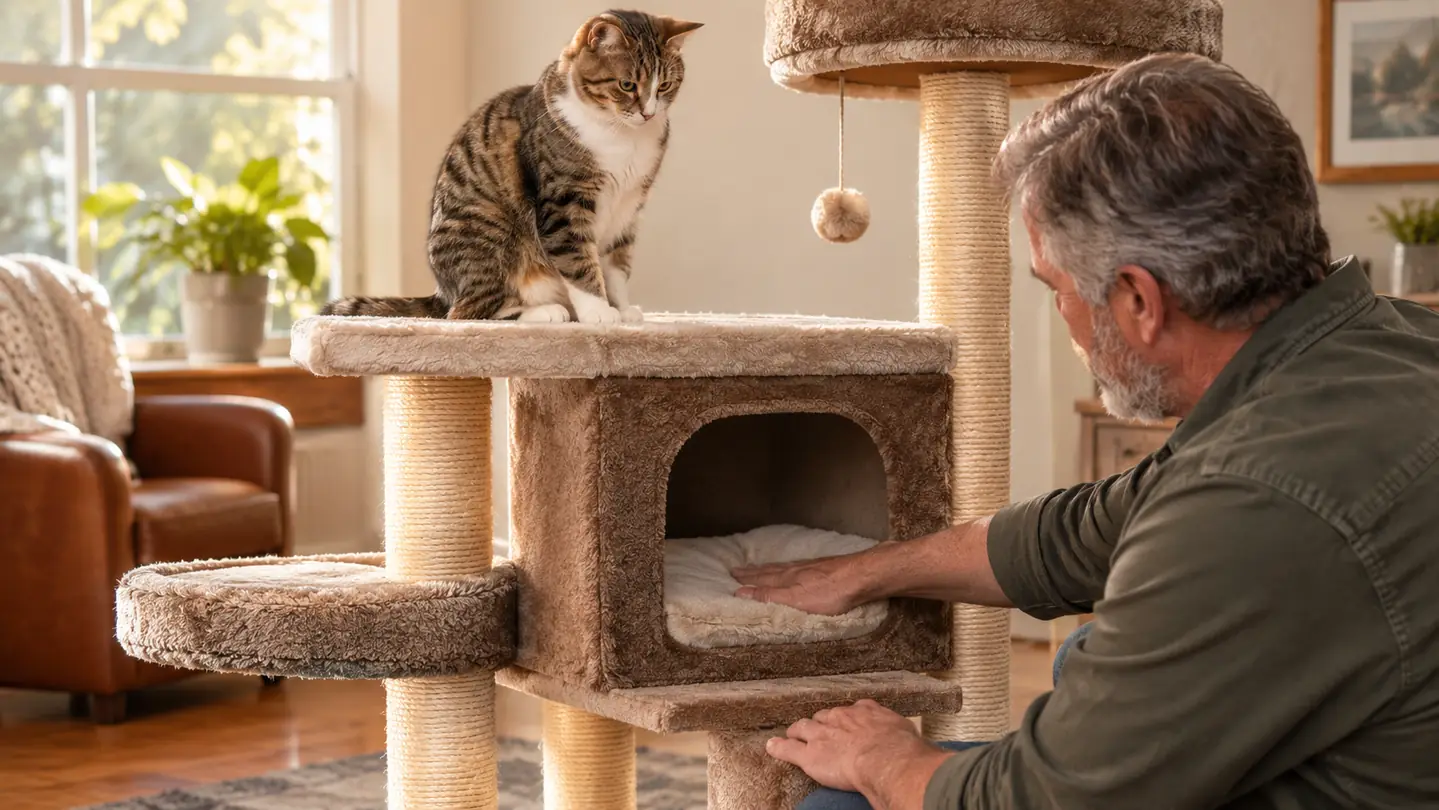
The listed numbers are honest, which is rarer than it should be. The base is 22.1 by 22.1 inches. The height is 47.9 inches. It weighs 40.5 pounds. Five levels, engineered wood, floor mounted, indoor use, hand wash only on the soft parts.
That 40.5 pounds is doing real work. Light cat furniture wobbles because it is light, and a cat launching off a top platform puts a surprising amount of sideways force into a frame. This one does not wobble. Not when Pip pushes off the top, not when Juniper misjudges her turning radius. If you have ever watched a cheaper tower lean into the drywall every time your cat jumped, you already know what the weight is buying you.
The footprint deserves an honest word. 22.1 inches square is compact for five levels, but you still need a clear corner. I put it where a floor lamp used to live and moved the lamp to the other end of the sofa. Measure first. I did, and it still felt larger in the room than it looked on paper, because a 47.9 inch object changes the sightline of a room. In a house with eight foot ceilings it reads as a piece of furniture rather than a pet product, which was the entire point of buying it.
The delivery is worth mentioning because it is the least glamorous part. The carton is roughly the size of a small refrigerator and it is not light. I unpacked mine in the hallway, which I regret, because the packing material shed little foam crumbs that I was still finding between floorboards a week later. Unpack it in the garage or on the porch, not on a rug you like.
My corner gives me about 26 inches of wall between the fireplace surround and the window trim, so 22.1 inches of base left roughly two inches of breathing room on each side. That is tighter than the product photos suggest and it still works, because the upper levels do not overhang the base. If your corner is under 24 inches, do the arithmetic before you order. The height is the other number to hold in your head. At 47.9 inches the top platform sits just below my shoulder, which makes it easy for me to reach in and smooth a cushion, and out of reach for a 45 pound dog with no climbing ambitions. That is not a coincidence. It is a large part of why the piece works in a room with a dog in it.
Engineered wood is the material, and it explains both why the VESPER photographs well and why I am about to tell you to treat it gently. It is not solid timber. No dragging it across a hardwood floor on its own base, no resting a sweating glass on the top platform. The care instructions say hand wash only, and that applies to the cushions rather than the frame.
The Cube, the Cushions, and the Posts
The cube is the part I underestimated. It has multiple exits, and that matters more than it sounds. A cube with one door is a trap from a cat's point of view, and Pip will not use a trap. With more than one way out, he treats it as a den instead of a box. He sleeps in it most afternoons, usually with a paw out of a side opening, which appears to be a supervisory position.
The cushions are memory foam. Pip is nine and a little stiff in the mornings, and he chooses the cushioned surfaces over the bare platforms almost every time, which tells me more than any product description could. The tradeoff is care. Hand wash only means no tossing them in with the towels. I spot clean, air dry, and rotate which cushion sits inside the cube so no single one takes all the wear.
I kept a rough count for the first month, mostly because I did not believe it would last. Pip used the cube on twenty-six of the first thirty days. He used the top platform on nineteen of them. He scratched the posts nearly every morning while I made coffee, a routine he already had before the tree arrived and has simply redirected. Before this piece that routine happened on the left arm of the sofa, and I had already gotten a quote on reupholstery. Twenty-six days out of thirty is the entire case for buying this thing.
Where he sleeps changed with the weather. Through the cold months he was in the cube almost exclusively, the cushion holding his own body heat. Since the house warmed up he has moved to the middle platform, where the afternoon light lands, and the cube has become the nap spot rather than the night spot. There are enough surfaces on five levels that the cat can move with the season instead of getting bored of one spot and going back to the sofa out of sheer tedium.
The scratching posts have held up better than I expected. Pip scratches hard, daily, mostly while waiting for breakfast. Five months in, the posts look used. They do not look shredded. The sofa arms look shredded. That is the comparison that actually matters, because a cat tree only earns its footprint if it redirects behaviour, not if it merely survives.
There are three cushioned surfaces in daily rotation if you count the cube and the two platforms, and I move them around every few weeks. That is not fussiness, it is a wear strategy. Memory foam takes a body-shaped dip, and shifting the cushions spreads the load before the dip sets. Do it early, not after you notice the sag.

What Five Months of Daily Use Did to It
Nothing dramatic, which is the report you want. No wobble, no hardware backing out, no finish chipping at the corners where Pip grips to haul himself up. There is a faint dust line on the top platform where the window light hits it. That is the entire list.
The honest wear is in the cushions. Memory foam softens under daily body heat and weight, and Pip's favourite has a slight dip in the middle now. It is still comfortable enough that he has not changed spots. I expect I will replace that cushion long before I replace anything structural, and I would rather have a soft part wear out than a load-bearing one.
February was the real test. Juniper comes in from the yard with mud on her legs and a habit of walking straight to the sun patch, which happens to sit about four feet from the base of the tree. I vacuumed the base and the lower platform every couple of days for roughly three weeks. The engineered wood wiped clean with a damp cloth and did not stain or lift. The cushion on the bottom level took a little more attention and I kept it out of the rotation until it dried properly. If you have a dog that goes outside in wet weather, put the tree somewhere the mud does not land, or accept that you will be wiping it down more often than you planned.
One thing I did not anticipate is dog hair at the base. Juniper sheds year round, and the lower platform and base plate sit at exactly the height where her coat brushes past on the way to the sun patch. A rubber brush once a week handles it in about a minute. The upper levels stay clean because she never gets up there. If you have a heavy-shedding dog sharing the room, budget that minute into your week and you will not notice it.
Five months also taught me something about placement that no review could have. I first had it against an interior wall, and Pip used it maybe half as much. I moved it to a corner where he can see the front door and the length of the hallway, and his use roughly doubled. Cat furniture rarely fails in the abstract. It fails because of where you put it.
Cleaning is a ten minute job with a vacuum brush attachment on the platforms and a damp cloth on the frame. Once a month I pull the cube cushion, spot clean it, and let it dry on the porch rail. That routine has kept the piece from developing any smell, which is not something I could say about the carpeted tower it replaced.
What I Liked
- 40.5 pounds on a 22.1 inch base means it does not shift or lean, even with a 45 pound dog cutting the corner
- Multiple exits on the cube turn it into a den instead of a trap, and Pip uses it daily
- Memory foam cushions get chosen over the bare platforms by an older, stiffer cat
- Engineered wood and clean lines read as furniture in a room with a cream linen sofa
- Scratching posts redirected Pip's daily scratching away from upholstery within weeks
Where It Falls Short
- Cushions are hand wash only, which means spot cleaning and air drying rather than a machine cycle
- 47.9 inches tall changes the sightline of a small room more than the spec sheet suggests
- A young, high-energy cat will want a bigger footprint and longer runways than five levels on 22.1 inches
- Engineered wood needs some care: no dragging, no wet glasses left on the top platform
- One cushion is already showing a slight dip after five months of daily use
Forty and a half pounds of engineered wood, and it has not wobbled once, not even the afternoon Juniper misjudged her landing.
Who This Is For
This is for the person whose living room is also a cat's living room, and who is tired of choosing between the two. If your furniture was chosen rather than inherited, if you have a sofa you actually like, and if you have a cat who has decided the sofa arm is a scratching post, this is the shape of the solution. It gives the cat somewhere better to be without costing you the room.
It also suits a mixed household better than I expected, as long as the dog is not a determined climber. Juniper ignores the platforms entirely. She uses the base as a corner to cut on her way to the sun patch, which is her only contribution to this review and, frankly, the most Juniper thing possible.
Who Should Skip It
Skip it if you have a kitten who wants a racetrack. Five levels on a 22.1 inch square base is a vertical setup, not an agility course. A young cat with that much energy will want runways, a wider base, and more open platforms. This piece rewards a cat who wants a high perch and a quiet den, which is a different animal entirely.
Skip it if hand washing cushions is a dealbreaker, or if you cannot give a 40.5 pound floor mounted object a permanent corner. And skip it if the household treats furniture roughly. This is a good-looking piece of engineered wood furniture. It is not indestructible and it does not pretend to be.
Pip claimed it in three days. Yours probably will too.
22.1 by 22.1 inch base, 47.9 inches tall, five levels, cube with multiple exits, memory foam cushions. See the current price and finish options on Amazon.
Amazon Check Today's Price on Amazon →