
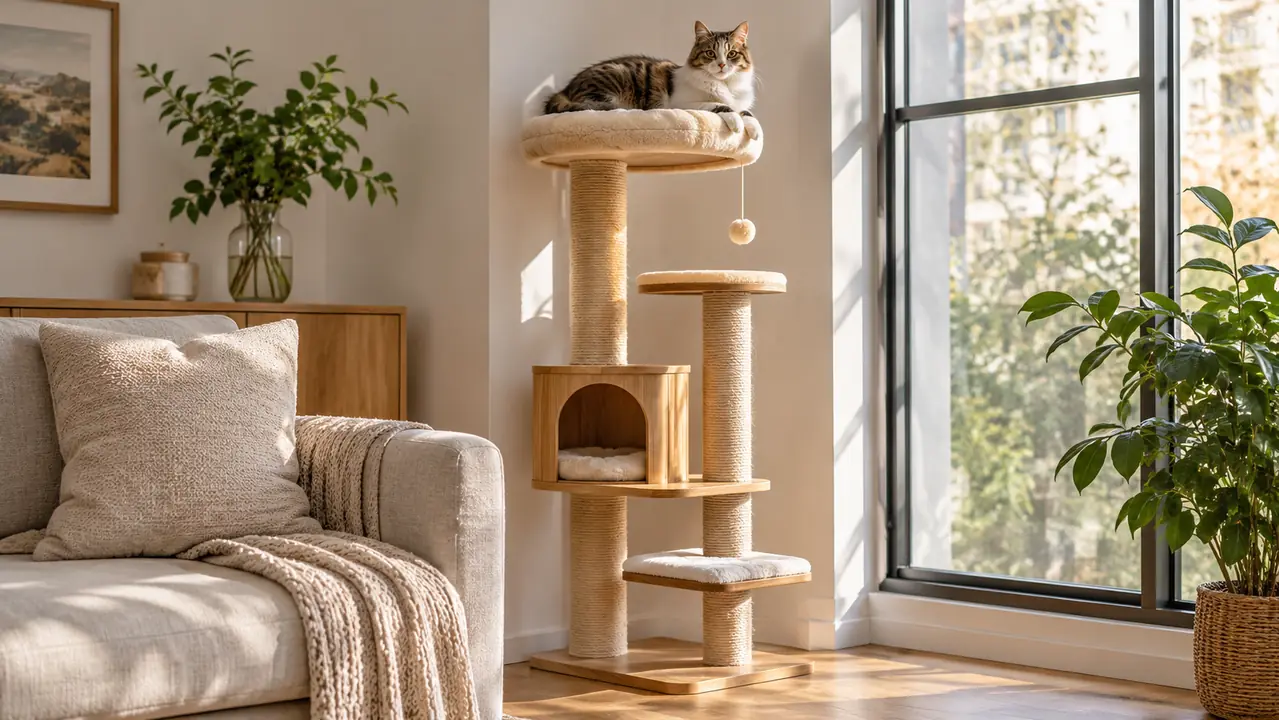
Pip is nine years old and he has firm opinions about upholstery. If I do not give him a better surface to dig his claws into, he takes it out on the arm of my cream linen sofa, and he does it slowly enough that I can watch him decide. So a cat tree was never optional in this house. The only real question was whether I could live with one in a room I actually like. That is the whole comparison in miniature. The VESPER Cat Tree is built to sit in a living room without announcing itself, and a carpeted cat tree is built to do the job and be seen doing it. Neither approach is wrong. They answer different questions, and the honest answer depends on which question you are asking.
I have had the VESPER Cat Tree, the high base model, in the corner of my 1940s bungalow long enough to know how it behaves in daily use. It is 47.9 inches tall on a 22.1 by 22.1 inch base, it weighs 40.5 pounds, and it has five levels. In practice, 47.9 inches puts the top platform just below the sill of my living room window, which is the height Pip actually cares about, and the 40.5 pound weight is the number that keeps it there. It arrived as flat panels in a single long box and took me one evening to put together by myself, with the five levels counted up from the base: the cube at the bottom and four platforms above it. I measured the corner before I ordered, because 22.1 inches square is not a guess you want to make twice in a 1940s bungalow where no corner is truly square. Those numbers matter more than any marketing line, because they tell you what the thing actually is: a tall, heavy, narrow-footprint piece of engineered wood furniture with a cube your cat can get inside, memory foam cushions on the platforms, and scratching posts built into the structure. A carpeted cat tree can be taller, wider, and less expensive. It will also be wrapped in the same plush material from the base to the top perch, and that single fact drives most of what follows.
Here is the short version, dimension by dimension. I have deliberately given the carpeted tree the rows it genuinely earns, because a comparison where one side wins every single line is not a comparison, it is an advertisement.
| VESPER Cat Tree | Carpeted Cat Tree | |
|---|---|---|
| Looks in a furnished room | Engineered wood panels, five clean levels, reads as furniture in a corner | Plush carpet from base to top perch, reads as pet equipment |
| Entry cost | Priced like a piece of furniture | Almost always the cheaper way to add vertical territory |
| Stability at full height | 40.5 pounds on a 22.1 by 22.1 inch base, sits flat and does not walk | Varies wildly by model, and the light ones flex when a cat lands hard |
| Cleaning off shed hair | Wood wipes down, cushions lift off and are hand wash only | Carpet traps hair, and a vacuum only reaches the top of the pile |
| Places for a cat to hide | One cube with multiple exits | Usually several enclosed cubbies, tunnels and hammocks |
| How it ages under heavy scratching | Scratches show on the posts and along the wood edges | Shredded pile looks rough, but the structure underneath survives |
| Floor space it claims | 22.1 by 22.1 inches, tucks into a corner | Often a wider base for the same height |
| Best for | A room you have finished and care about | A dedicated cat room or a finished basement |
Where the VESPER Cat Tree Wins
The first thing the VESPER gets right is that it does not look like a cat tree. It looks like a narrow shelving piece that happens to have a cube in it. The engineered wood panels are flat and clean, the platforms line up, and from the doorway of my living room it reads as furniture rather than pet gear. What I tried first, three winters ago, was a plush tower I moved into that same corner and then moved straight back out. It stood 63 inches tall, it covered the corner from the baseboard to above the window ledge, and the pile was a beige that fought with the light oak floor and the cream sofa in a way I could not style around. Every photograph I took of that corner looked like a shot of a cat tree. Nobody saw the room. I moved it to the back of the house within a month, and that is the honest origin of this comparison. I spent years styling around pet equipment for clients who loved their cats and hated what their cats' belongings did to a room, and the pattern repeated itself in house after house. A tree that fits the room gets used. That is the entire argument, and it is worth more than any single feature on the spec sheet.
The second thing it gets right is the base. A 22.1 by 22.1 inch footprint carrying 40.5 pounds of engineered wood is a combination that does not walk across a floor when a cat launches off the top platform. I have watched Pip jump onto it from the back of the sofa, and the whole structure absorbed the landing without a wobble. The jump is about four feet, from the sofa back to the second platform, and he lands with his whole weight forward. I tested it myself the way you test a bookshelf, with one hand flat on the top level and a hard push, and nothing tipped or creaked. What I watch for instead is the slow drift, a tree that has shifted two inches across the floor over a winter so that the corner you measured no longer matches the corner it sits in. This one has not moved. When Pip lands he settles on the second platform, not the top, and works his way up one level at a time, which tells me the open spacing between levels is comfortable for a nine-year-old cat rather than something he has to haul himself over. Lightweight carpeted towers in the same height class flex under that kind of hit, and once a cat feels a flex it stops trusting the upper levels, which quietly turns a tall tree into a short one.
The cube deserves its own mention. It has multiple exits, which sounds like a minor design detail and is not. A single-opening cubby is a trap as far as a cautious cat is concerned, and it gets abandoned the first time the dog walks past the entrance. Multiple exits means Pip uses it as a through-route and a napping spot instead of a place he avoids. The memory foam cushions are the reason he stays up there for three hours at a stretch, since they compress like a real bed cushion rather than a thin pad over a board. And the scratching posts are integrated into the structure rather than bolted on as an afterthought, which matters because Pip scratches on his way up, not at a dedicated station. The tradeoff is that the cushions are hand wash only, so hair comes off with a lint roller and a wash is a planned event, not a quick spin in the machine.
Forty point five pounds on a 22.1 inch base is what stops a cat tree from walking across the floor when a cat launches off the top level.
Where a Carpeted Cat Tree Wins
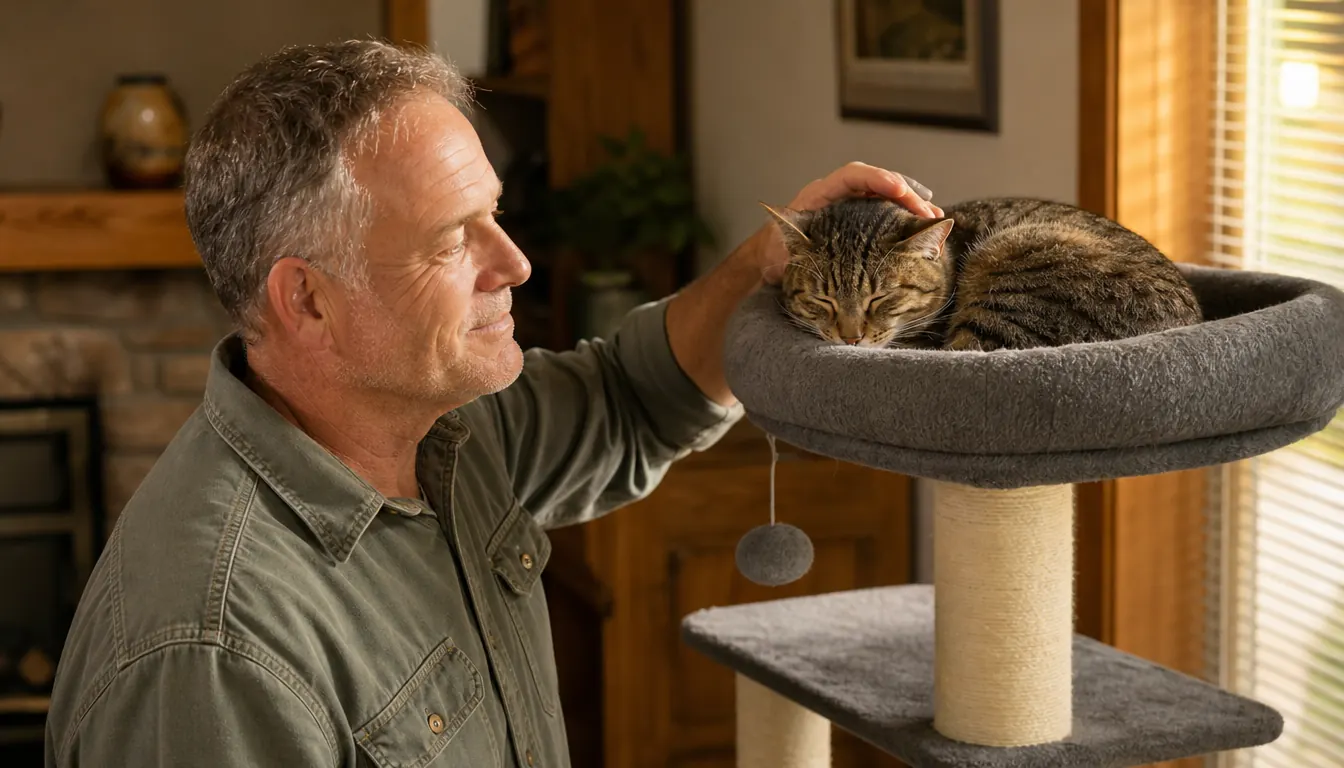
Now the part that will annoy people who already bought the VESPER. A carpeted cat tree wins on cost, and it is not close. If the goal is maximum vertical territory for the least money, plush carpet over particleboard is how that gets delivered, and a large multi-level carpeted tower can come in below a wood piece of half the height. It also wins on hiding places, clearly. Carpeted designs are usually built as a stack of enclosed cubbies, tunnels and hammocks, and if you have a cat who wants to be invisible for sixteen hours a day, that is a real advantage the VESPER simply does not offer. The VESPER gives you one cube. A carpeted tower gives you a warren. One client of mine had a tower with four enclosed cubbies stacked in a column, and her cat spent every daylight hour in the third one up, nose out, watching the hallway. You cannot replicate that with a single cube. If your cat is the kind that flattens itself under a bed when the doorbell rings, the enclosed options are the entire reason to buy a carpeted tree, and no amount of clean wood grain makes up for a hiding place that does not exist.
The second honest win is how carpet ages under abuse. Carpet is forgiving. When a cat shreds carpet, the pile mats and fuzzes and starts to look rough, but the structure underneath keeps working, and nobody gashes a shin on a corner of it. Engineered wood is less forgiving. A determined cat will leave visible scratches on the post wraps and along the edges of the panels, and those marks do not blend in the way carpet fuzz does. My VESPER has a few. I have decided they are patina, which is what people say when a wood surface gets marked, but a buyer deserves to know they are coming. Carpet also deadens sound, so a cat landing hard at two in the morning is noticeably quieter on a plush tower than on a wood platform in a room with hardwood floors. And carpet hides the everyday mess in a way wood cannot. Hair works down into the pile and stays there, which is unpleasant when you think about it and convenient when you do not. A wood surface shows every strand, so the VESPER gets a pass with a lint roller every second evening, and I keep one in the drawer of the side table purely for that job.
If the room matters as much as the cat, start here
The VESPER Cat Tree is 47.9 inches tall on a 22.1 by 22.1 inch base, 40.5 pounds, five levels, with a cube that has multiple exits and memory foam cushions on the platforms. It is the version you keep in the living room instead of hiding in the spare bedroom.
Amazon Check Today's Price on Amazon →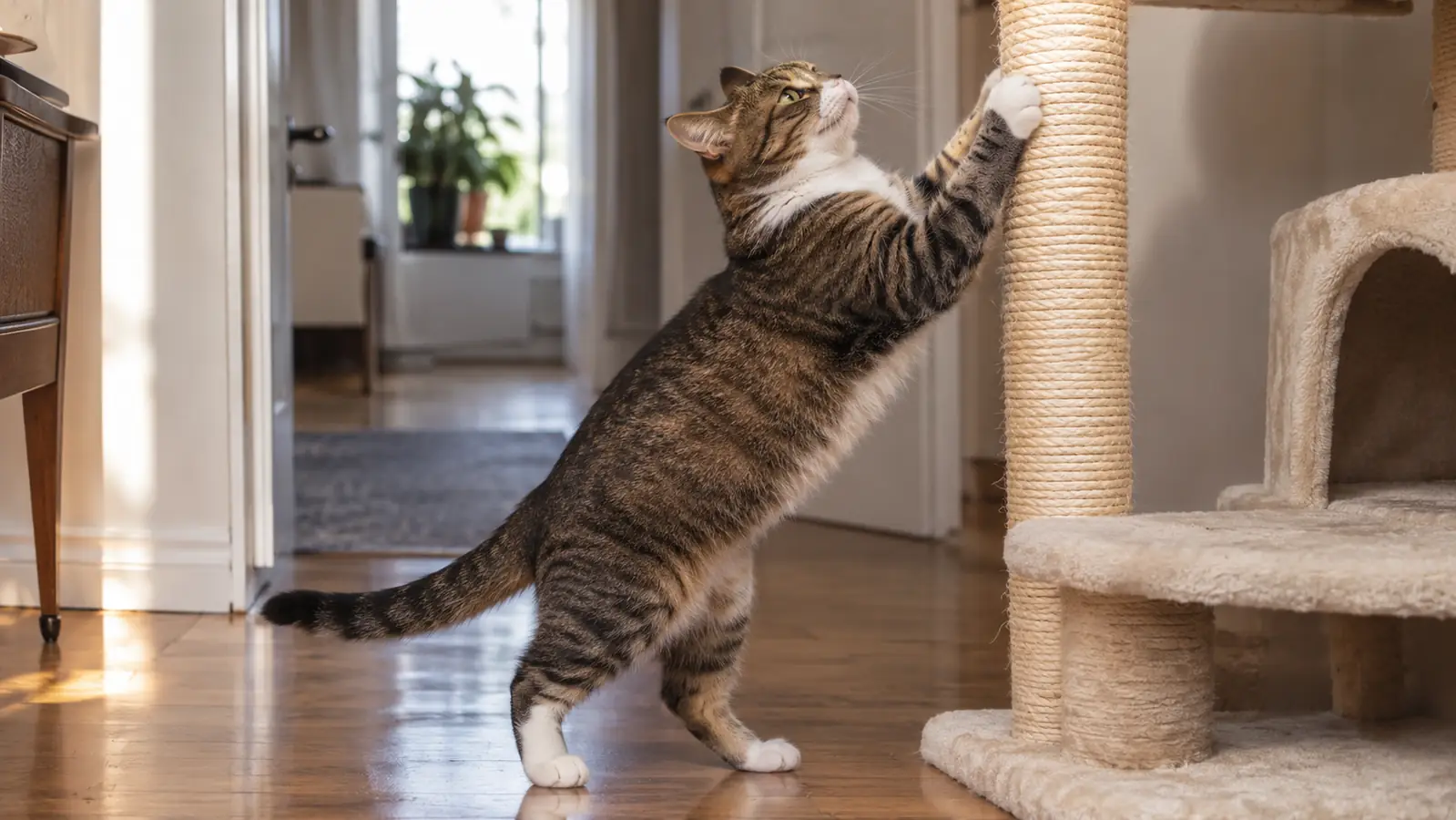
Who Should Buy Which
Buy the VESPER if the tree is going into a room you have already finished. That is the test, and it is a better test than any breed, age or activity level you could name. If guests see it, if it sits beside a window you like to look out of, if you have ever dragged a piece of pet furniture into a basement purely to get it out of sight, the VESPER solves a problem a carpeted tree cannot solve at any discount. It suits a single cat or two who like to be up high and visible, and it suits a household where the cat is already allowed on the furniture, because the whole point is that the tree does not look like a compromise you made.
Buy a carpeted cat tree if the tree is going somewhere that is already a cat space, or if budget is the deciding factor, or if your cat genuinely lives inside cubbies and only emerges to eat. There is no shame in it. A big plush tower in a finished basement is a great use of the money, and a cat who wants to be enclosed will choose tunnels over open platforms every single time, no matter how good the wood looks. Just be clear-eyed about the trade. You are buying concealment and territory, and you are paying for it with the look of the thing and with hair you will never fully vacuum out of the pile. If a guest room is where it lands, the guest room is where it stays.
There is a third option, which is both, and it is less silly than it sounds. Plenty of households run a carpeted tower at the back of the house and a wood piece in the front room. The cat gets the warren. The living room gets something you can stand to look at. You will spend more than you planned, and you will spend it twice, and the arrangement will outlast both pieces. It is not a compromise so much as an admission that one piece of furniture cannot do every job well. If you are choosing only one, choose based on the room rather than the cat, because a cat will use whatever is in the room it wants to be in, and the room it wants to be in is the one where you are. Pip ignored a perfectly good tower in a spare bedroom for two years and took to the VESPER in a week.
One tree, one corner, no plush column in the living room
22.1 by 22.1 inches on the floor, 47.9 inches tall, 40.5 pounds, five levels of engineered wood. Built to be furniture first and cat gear second.
Amazon See the VESPER Cat Tree on Amazon →